
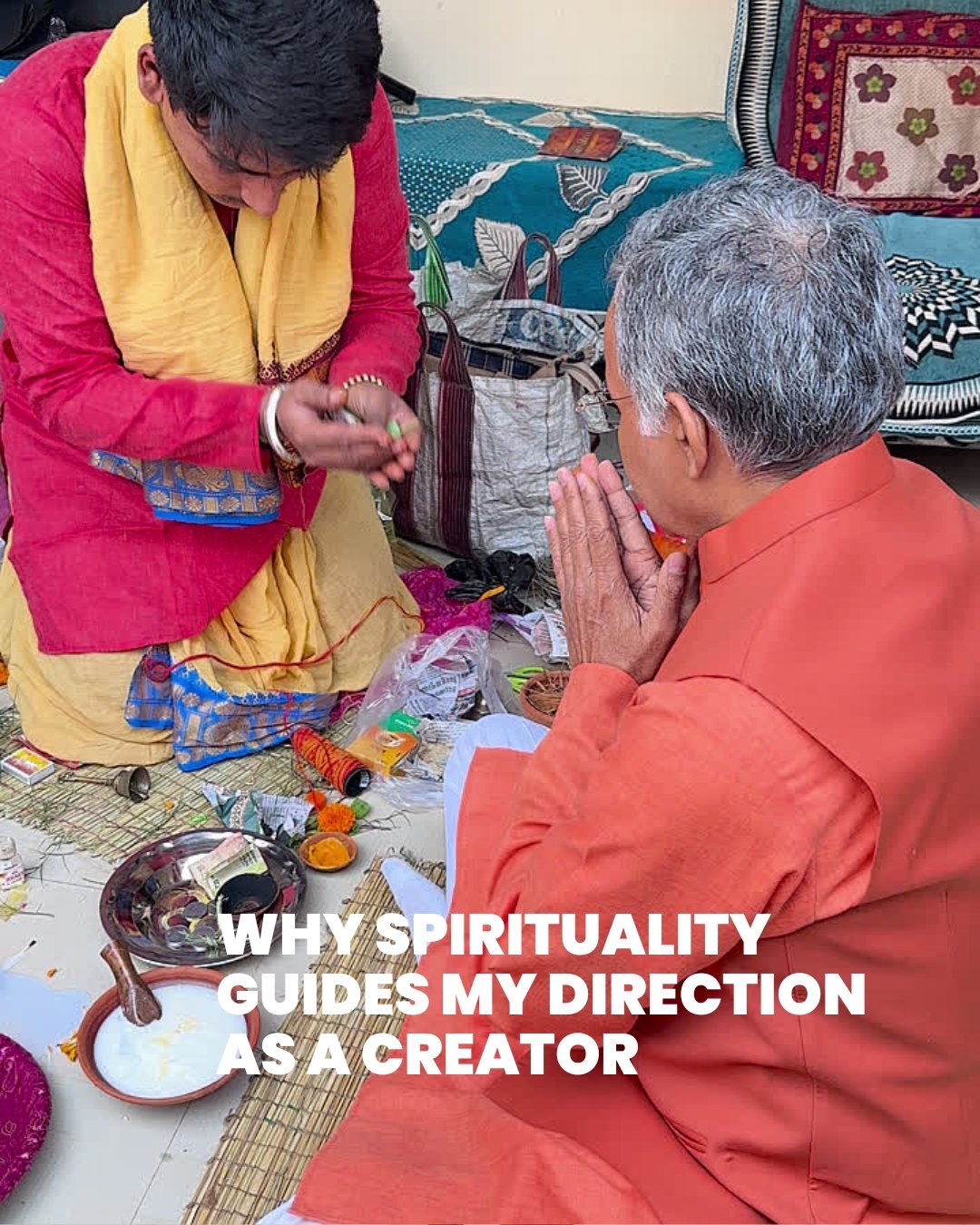
On the morning we began shooting Avyaan, the first thing that happened was not a camera
rehearsal or a lighting check. It was a puja. Pandit Sourav Banerjee led us through the
rituals on the banks of the Ganga, and only after that ceremony was complete did the
production formally begin.
I have been asked, more than once, why a film production would start this way. Why not
simply begin shooting and treat the spiritual dimension of the story as something to capture
on screen, rather than something to practice off it. I understand the question. But for me,
the distinction does not hold. I do not think you can authentically tell a story about spiritual
searching while treating spirituality itself as a subject to be observed from the outside. It
has to be something you actually orient your direction by — not just your characters’
direction, but your own.
This is what I want to explain here: not spirituality as a theme in Avyaan, but spirituality as
the compass I use to make decisions as a creator.
Spirituality as Orientation, Not Decoration
I touched on this in an earlier reflection on culture and creative responsibility — the
difference between using tradition as decoration and engaging with it as substance.
Spirituality, for me, sits at the center of that distinction.
It would be easy to make a film with spiritual imagery — temples, rivers, rituals — without
the production itself being guided by any spiritual discipline. Many films do exactly this,
and audiences can usually tell. The image looks right, but something underneath it feels
hollow.
What I have tried to do instead is let spiritual discipline guide the actual decisions of the
production, not just its visual content. That starts with how we begin — with a ceremony,
with intention, with humility about what we are attempting to do. It continues through how
we choose locations, how we treat the people and places we film, and how we measure
whether a day of work has gone well. A day where the team worked with patience, respect,
and genuine presence matters more to me than a day where we simply captured more
footage.
What Sanatan Values Teach About Creative Work
Sanatan philosophy carries a particular understanding of action — the idea that how you act
matters as much as what you achieve, and that work done with the right intention carries its
own value independent of outcome. This idea, more than any other, shapes how I approach
producing.
In business, I learned this lesson slowly, over years, often through situations where the right
outcome and the right process did not initially seem aligned. In filmmaking, I have tried to
apply it from the start. The instinct in commercial filmmaking is often to optimise
relentlessly for outcome — box office, engagement, attention. I do not dismiss those
measures entirely. But I have made a deliberate choice to weigh them against a different
question: was this made with the right intention, and was the process itself conducted with
integrity?
This is not abstract idealism. It shapes concrete choices. It is why we shot Avyaan in
Varanasi itself rather than recreating it elsewhere. It is why the production began with
genuine ritual rather than a staged version of one for marketing purposes. It is why
decisions about how to depict spiritual practice in the film were made in consultation with
people who understand that practice deeply, rather than left to creative instinct alone.
The Discipline of Stillness in a Restless Industry
One of the more counterintuitive things spirituality has given me as a creator is comfort
with stillness, in an industry that often treats stillness as a failure of pacing.
Contemporary content, across almost every medium, is built around constant motion —
cuts, reveals, escalation. There are good reasons for this; attention is hard to hold, and
pacing matters. But spiritual practice teaches something different: that stillness, approached
correctly, is not empty. It is often where the most significant things happen. A moment of
quiet reflection, a long unbroken shot of a river at dawn, a scene where very little is said
but a great deal is felt — these moments require trust, both from the filmmaker and from
the audience.
Avyaan leans into this trust more than a conventional commercial film might. The
characters — Aakash, Shivani, Astik, and Purab — each move through searching that does
not resolve in dramatic, fast bursts. It resolves, when it resolves at all, in quieter
recognitions. That structure reflects something I believe spiritually: that the most important
shifts in a person’s understanding rarely arrive as spectacle. They arrive in stillness, after
the noise has settled.
Trusting that structure, as a producer, took a kind of faith I do not think I would have had
without years of spiritual grounding behind me.
Spirituality and Responsibility to the Sacred
There is a particular responsibility that comes with filming in a place like Varanasi — a city
that is, for millions of people, genuinely sacred, not symbolically sacred. That distinction
matters enormously to how I direct a production.
When you film in a sacred space, you are a guest. The city, the river, the rituals that take
place there did not arrange themselves for your camera. My spiritual orientation is what
keeps that fact in front of me at every stage of decision-making. It is why our approach to
Varanasi was built around participation and respect rather than extraction — beginning with
ritual, working with people who understand the city’s spiritual rhythms, and shaping our
shooting schedule around the city’s own life rather than the other way around.
I think a purely commercial orientation would have made different choices here — faster,
more convenient, less respectful of the place. Spirituality, as a guiding discipline rather than
just a backdrop, is what prevented that.
Why This Matters Beyond One Film
I do not think this way of working is relevant only to Avyaan, or only to projects that are
explicitly about spirituality as subject matter. I think it is a broader argument about how
creative work, of any kind, benefits from being guided by something larger than
commercial calculation alone.
Spiritual discipline, in my experience, sharpens creative judgment rather than softening it.
It asks harder questions about intention. It demands more patience with process. It resists
the temptation to optimise purely for immediate impact at the expense of lasting meaning.
These are not religious claims. They are practical observations from someone who has
spent decades building things — first in business, now in film — and who has found that
work guided by genuine values tends to last longer and mean more than work guided by
expedience alone.
A Closing Reflection
I am not a filmmaker by training, and I do not claim spiritual authority of any kind. What I
can offer is honesty about what has actually guided my decisions as a producer, scene by
scene, choice by choice, throughout the making of Avyaan.
That guide has been a spiritual discipline — not as a theme to depict, but as a compass to
follow. It shaped how we began, how we worked, and what we were willing to sacrifice in
pursuit of commercial convenience. I believe that discipline is present in the finished film,
even in moments that have nothing explicitly to do with religion or ritual. It is present in
the patience of the storytelling, the respect shown to Varanasi, and the trust placed in
stillness over spectacle.
That is why spirituality guides my direction as a creator. Not because it makes for good
marketing language, but because I do not know how to make work I believe in without it.
To follow the full journey of Avyaan and Sunil Kothari’s creative work, visit the Film
Productions section of this site.