
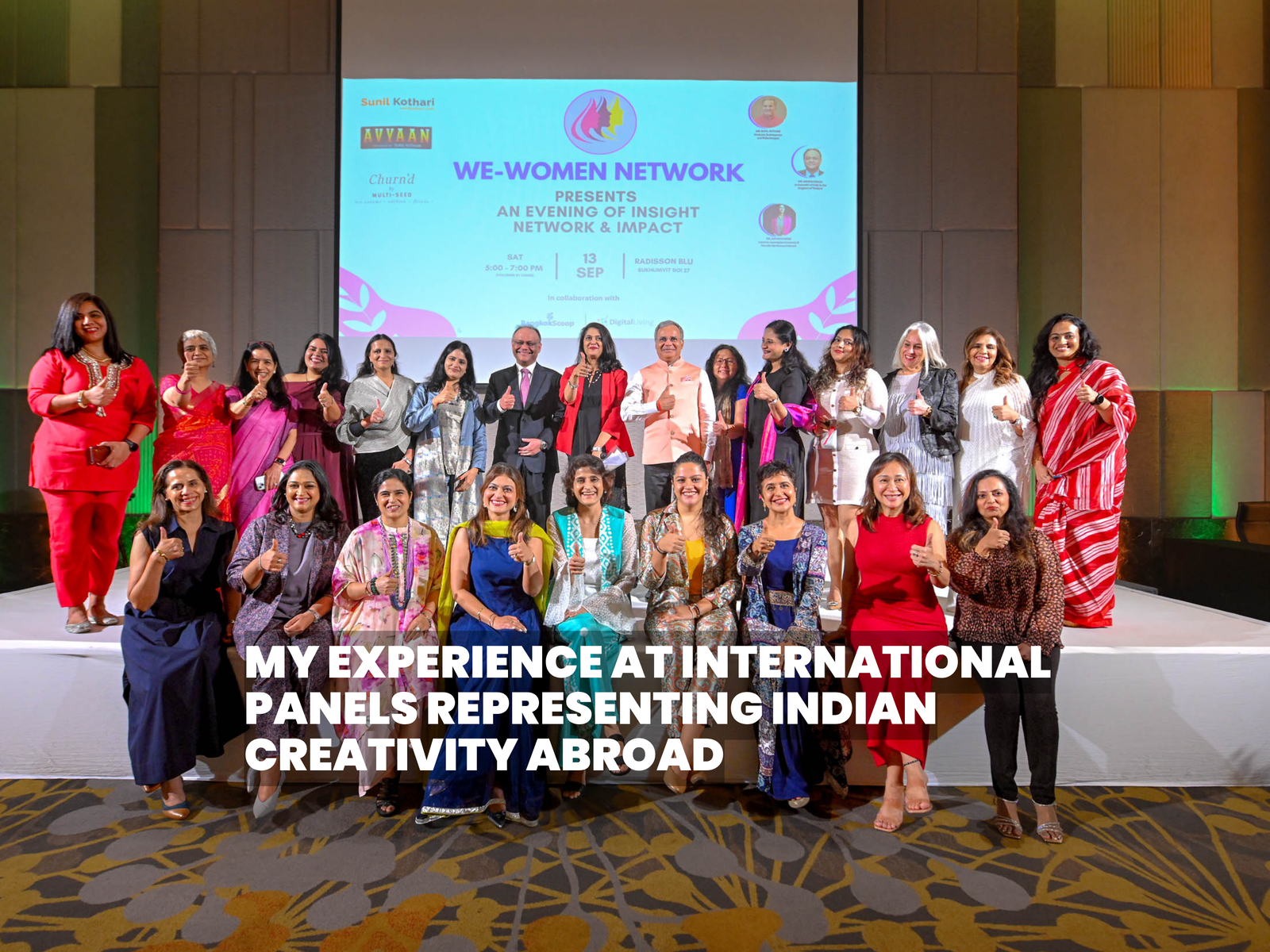
A few months ago, I found myself on stage at a We-Women Network event in Bangkok,
organised in collaboration with BangkokScoop, sitting alongside leaders from across
industries for a global panel on equality and inclusion. The evening was not built around
film. It was built around women’s leadership, philanthropy, and the kind of dialogue that
crosses cultures more easily than business deals usually do. And yet, by the end of the
evening, the room had also seen the first teaser of Avyaan — a quiet, unplanned
convergence of two things I care about deeply: empowerment and Indian storytelling.
That evening captured something I have come to understand clearly after years of
representing Indian business and culture in international settings: panels are not really
about the topic printed on the programme. They are about what you choose to carry into the
room, and what the room ultimately remembers you for.
Why Panels Matter More Than They Seem To
I have sat on panels in Bangkok for decades, long before I had any involvement in film —
representing the India-Thai Chamber of Commerce, speaking at cultural events,
contributing to discussions on trade, philanthropy, and community life. The format itself
can seem modest. A handful of speakers, a moderator, and an hour of conversation. It is easy to
underestimate.
But I think panels are one of the most underrated platforms for representing a culture
honestly, precisely because they are conversational rather than scripted. A keynote speech
lets you control the narrative completely. A panel does not. You are responding in real time,
alongside people who may see things differently, in front of an audience that is watching
not just what you say but how you listen, how you engage, and how you carry yourself
under a question you did not anticipate.
That unscripted quality is exactly what makes panels valuable for representing Indian
creativity abroad. It is one thing to present India’s cultural depth in a polished, pre-prepared
format. It is another way to demonstrate that depth in live conversation, responding honestly to
questions from people who may know very little about Sanatan values, about Varanasi,
about what a film like Avyaan is actually trying to do.
What It Means to Represent a Culture, Not Just a Project
When I am invited to speak at international panels now, I am rarely there purely as a
businessman or purely as a filmmaker. I am usually there as someone who has spent over
forty years bridging India and Thailand, and increasingly as someone trying to bring Indian
storytelling to audiences who may never have engaged with it seriously before.
This carries a responsibility I take seriously. When I speak about Avyaan, I am not simply
promoting a film. I am offering, to an international audience, a window into values —
Sanatan philosophy, the spiritual significance of Varanasi, the idea that inner strength and
rootedness matter as much as outward achievement — that many in the room may be
encountering for the first time. I try to speak about these things with the same care I
described in an earlier reflection on creative responsibility: not as exotic colour for an
audience, but as substance that deserves to be understood on its own terms.
This is harder than it sounds. International audiences often want cultural content delivered
as something easily digestible — a neat summary, a relatable hook. I have learned, over
many panels, to resist flattening the material too much. Some concepts deserve to remain a
little unresolved, a little untranslatable, because that is honest. Audiences respect that
honesty more than they respect oversimplification, even if it asks slightly more of them.
The We-Women Network Evening: A Case Study in Unexpected Convergence
The Bangkok evening I mentioned earlier is a good example of what I mean by carrying
culture into a room rather than waiting for the right occasion to present it.
The event itself was focused on women’s leadership and the global equality panel, “Beyond
Gender” — a conversation about inclusion, leadership, and the future of women across
cultures, organised in partnership with BangkokScoop and supporting Baan Unrak
Children’s Home. I was there in a philanthropic capacity, not a promotional one. But the
evening also became the moment we unveiled the first teaser of Avyaan to a live audience
for the first time.
What struck me was how naturally those two threads — women’s empowerment and a film
rooted in Indian spiritual tradition — sat alongside each other. Neither overshadowed the
other. The audience that evening was engaged in a serious conversation about leadership
and inclusion, and within that same evening, they were also introduced to a story about
searching for identity and meaning in Varanasi. I did not plan that convergence deliberately,
but it reinforced something I believe: cultural representation does not need its own separate
stage. It can, and probably should, sit comfortably alongside other serious conversations,
rather than being treated as a niche addition.
Lessons From Years of Cross-Cultural Dialogue
A few things I have learned, after many years of representing Indian business, philanthropy,
and now creative work, in international settings:
The first is that specificity earns more respect than generality. When discussing India on an
international panel, it is tempting to speak in broad strokes — “rich culture,” “ancient
traditions,” “spiritual depth.” These phrases are not wrong, but they are forgettable. What
actually lands with an audience is specificity: the particular meaning of a word like Avyaan,
the particular significance of a city like Varanasi, the particular ritual of a puja ceremony
conducted by Pandit Sourav Banerjee on the banks of the Ganga. Specific details give an
audience something to actually hold onto.
The second is that humility opens more doors than authority. I am not an academic or a
cultural historian. When I speak about Sanatan values or Indian spiritual tradition on a
panel, I try to speak as someone who has lived adjacent to these traditions and is trying to
represent them honestly, not as someone claiming definitive expertise. Audiences, in my
experience, respond far better to genuine humility than to performed authority.
The third is that representing a culture abroad means representing it as something alive, not
historical. It would be easy to discuss India’s traditions purely in the past tense — as
heritage, as history. I try, instead, to present these values as something actively shaping
decisions today: how we chose to shoot Avyaan, how we approached Varanasi, how a puja
ceremony shaped the beginning of a film production in 2024, not centuries ago. Living
tradition is more compelling, and more honest, than nostalgic tradition.
Why This Work Matters Beyond Any Single Panel
I do not think the value of these conversations lies in any individual appearance. It lies in
the accumulation — the slow, consistent presence of Indian voices, Indian stories, and
Indian values in international rooms where they might not otherwise be heard with depth.
Every panel I sit on, every conversation where Avyaan comes up alongside discussions of
leadership, philanthropy, or business, is a small contribution to a larger picture: the idea that
Indian creativity and Indian cultural depth belong in serious international conversation, not
as a special category, but as part of the same conversation everyone else is having about
leadership, meaning, and purpose.
That is the responsibility I try to carry into every panel I am invited to join. Not to perform
Indian-ness for an audience, but to bring genuine substance into rooms that are often
hungry for exactly that, even when they do not know to ask for it directly.
To learn more about Sunil Kothari’s background and the values guiding his international
work, visit the About page of this site.